
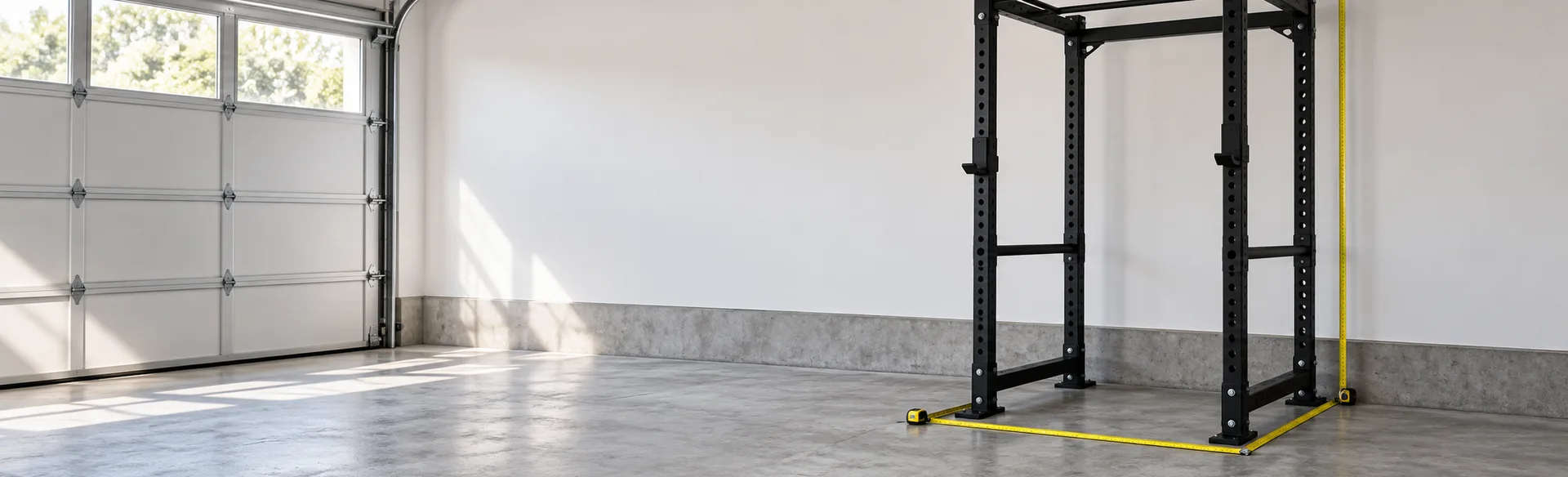
 ← Will your rack fit?
Measure your space.
Record these six checks, then compare your room with the rack dimensions.
Six quick checks
Use a tape measure and record each reading.
How to measure
Measure where the rack will stand.
Ceiling height
Measure floor to the lowest point above the rack area. Check beams, pipes, lights, and soffits; record the lowest reading.
Usable floor width
Measure between fixed obstacles where the rack will stand. Leave out furniture and anything that stays in the training area.
Usable floor depth
Measure from the wall behind the rack to the nearest fixed obstacle in front. Leave out furniture and stored items.
Narrowest point on the route
Measure each doorway and hallway pinch point at its narrowest. Include frames, handles, and raised thresholds; record the smallest opening.
Stairs and turns, if any
Measure stair width and height from each tread to the lowest point above. Check that each landing has room for a long package to turn.
Floor surface and level
Look for soft, damaged, sloped, or uneven spots beneath each foot. Press down and note any flex or rocking.
Easy mistakes to avoid
Small shortcuts can lead to the wrong fit decision.
- Measuring the room’s average ceiling height
- A beam or pipe may be lower and block the rack.
- Counting space occupied by furniture
- The rack may fit on paper but not in the room as used.
- Ignoring frames, handles, or thresholds
- The doorway may be narrower than your measurement.
- Measuring stair width but not the turns
- A long package may not clear the landing.
- Checking footprint but not working space
- There may be too little room to change plates or move around the rack.
- Skipping the floor beneath the rack feet
- Uneven flooring can leave the rack unstable.